COP
The coefficient of performance: heat out divided by electricity in, measured at one set of conditions, such as a particular outdoor and water temperature. Useful for comparing machines on a test bench.
Plain English · checked 3 November 2026
A heat pump does not burn anything. It moves heat that is already outside into your home, the way a fridge moves heat out of its box, and uses electricity to do the moving.
The idea
A gas boiler makes heat by burning gas. An electric heater makes heat from electricity, one unit of heat for each unit of electricity. A heat pump does something different: it moves heat that already exists in the outside air, the ground or a body of water, and concentrates it at a temperature that can warm radiators and a hot water cylinder.
The moving is done by a refrigerant, a fluid that boils at very low temperatures. In the outdoor unit it boils as the air warms it; a compressor squeezes the vapour, which raises its temperature; the hot vapour gives its heat to the water inside the home; and an expansion valve drops the pressure so the cycle can start again. The electricity runs the compressor and the fans. It is the same principle a fridge uses, run the other way round.
Because most of the heat comes from outside, a heat pump delivers more heat than the electricity it uses. That ratio is its efficiency, and it is the number that decides everything else, from running cost to radiator size. The step-by-step guide follows a unit of heat round the loop.
The types
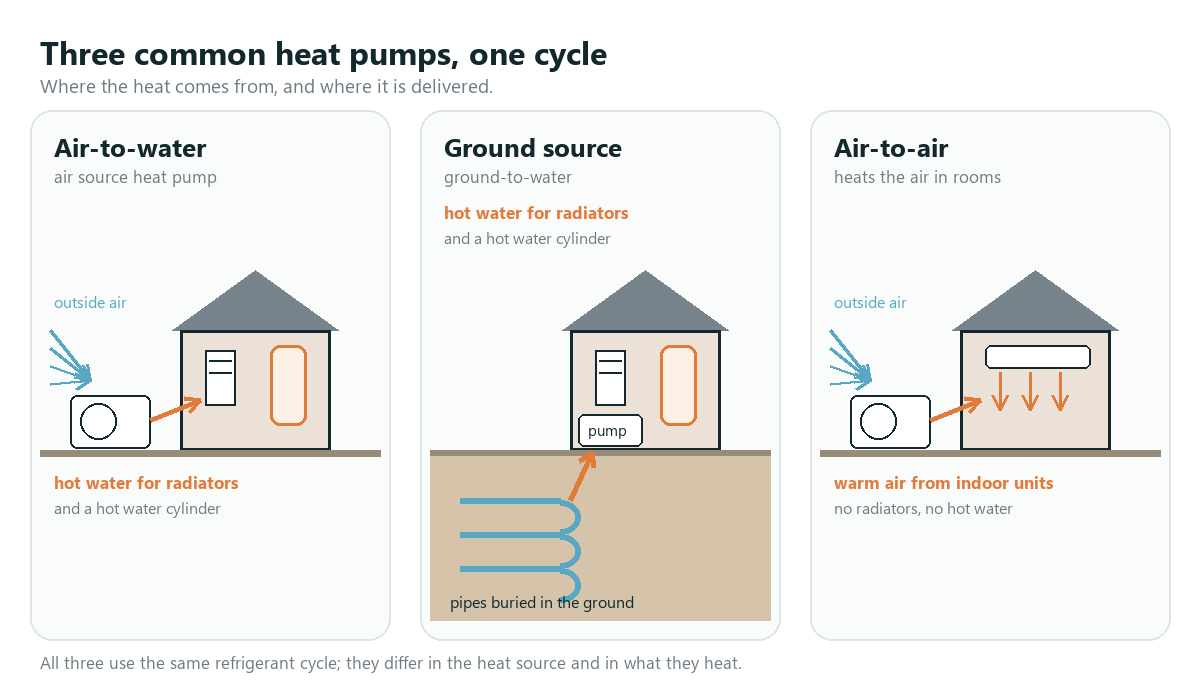
Air-to-water is the type most UK homes mean by "heat pump". Ground source collects heat through buried pipes. Air-to-air heats rooms directly and makes no hot water. A hybrid pairs a heat pump with a boiler. The types guide compares them.
Efficiency
The coefficient of performance: heat out divided by electricity in, measured at one set of conditions, such as a particular outdoor and water temperature. Useful for comparing machines on a test bench.
The seasonal coefficient of performance: a weighted average over a standard heating season, calculated from tests. It is the figure on product labels and data sheets.
The seasonal performance factor: what a real system achieved over a real season in a real home. Field trials measure it. The Electrification of Heat trial's interim median for air source was 2.80.
The efficiency guide explains where the boundaries are drawn and why the same machine can show different numbers.
Running cost
Electricity costs more per kWh than gas: on the Ofgem price cap for 1 October to 31 December 2026, 26.32p against 7.97p. That comparison is misleading on its own, because a kWh of electricity in a heat pump delivers several kWh of heat, while a kWh of gas in a boiler delivers a little under one.
The honest comparison divides each unit price by the system's efficiency. At the cap rates, a heat pump achieving 2.8 gives heat at about 9.40p a kWh. A gas boiler at an assumed 90% gives it at about 8.86p. A direct electric heater gives it at 26.32p. So against gas the result is close and turns on efficiency and tariff; against direct electric heating, the heat pump's heat costs roughly a third as much per kWh.
Electricity on Great Britain's domestic bills carries no VAT from 1 October 2026 to 30 June 2027, under HMRC's temporary zero rate. The cost calculator lets you put in your own tariff and efficiency, and shows the price per kWh of heat for all three systems. It deliberately does not estimate a yearly bill.
Pence per kWh of heat, cap rates
Unit rates from Ofgem, 1 October to 31 December 2026. Standing charges not included.
Your home
More than most people expect. The Electrification of Heat demonstration, run by Energy Systems Catapult with government funding, installed 742 heat pumps across a range of British homes and concluded that heat pumps can be successfully installed in all the types of property it tested. What varies is the work involved.
The government's explainer lists the practical points: you need space for the heat pump and a water cylinder, and some radiators may need to be changed for larger ones. Insulation helps, because a home that loses less heat needs a smaller heat pump and lower water temperatures, but a heat pump can be designed for a home as it is. The suitability guide covers older homes, flats and small spaces.
Hybrids
A hybrid system pairs a heat pump with a boiler, usually gas, and switches between them, often using the boiler on the coldest days or for hot water. It can suit a home where a full heat pump system is hard to fit. GOV.UK says the Boiler Upgrade Scheme does not fund hybrids, and Home Energy Scotland's scheme excludes them too. The hybrid guide explains how they decide which source to use.
Where homes are now
The 2021 census found that 74% of households in England and Wales relied on mains gas alone. About about 2.1 million used electric heating only, 865,940 used oil only, and 98,730, under one per cent, used renewable heating such as a heat pump alone.
The government's grant data shows what heat pumps are replacing. Of the heat pumps paid for by the Boiler Upgrade Scheme in England and Wales between May 2022 and September 2026, 55% replaced mains gas, 18% oil and 10% direct electric heating, while 13% went into homes with no previous heating system. The data page has the full breakdown.
Common doubts
Yes. The refrigerant boils well below zero, so there is heat to collect in cold air. Efficiency falls as the outdoor temperature drops, and the unit defrosts its coil from time to time. See cold weather.
They run cooler for longer, which feels different. A good design sizes radiators so rooms reach temperature at a low flow temperature. See flow temperature.
The outdoor unit makes a steady fan and compressor sound. How much reaches a neighbour depends on distance and surroundings. See noise.
Every guide
A machine that moves heat from outside air, the ground or water into a home, using electricity to drive a refrigerant cycle rather than to make the heat directly.
The government's own explainer says heat pumps can produce around 3 units of heat for every unit of electricity they use. In the Electrification of Heat trial, the interim median for air source heat pumps was 2.80 over a season.
It depends on the two unit prices and the heat pump's real efficiency. At the price cap for 1 October to 31 December 2026, a heat pump at 2.8 gives heat at about 9.40p a kWh and a 90% gas boiler at about 8.86p. The cost calculator lets you use your own tariff.
The Electrification of Heat project concluded that heat pumps can be successfully installed in all the types of property it tested. What changes from home to home is the size of heat pump, the radiators and the space for a cylinder, which a proper design works out.
Not through the Boiler Upgrade Scheme, which GOV.UK says does not fund hybrid systems such as a gas boiler with an air source heat pump. Air-to-air heat pumps in homes can get a smaller grant of £2,500.
Who publishes this
Published by SEO-DONS LTD (company no. 16766013), 71-75 Shelton Street, Covent Garden, London WC2H 9JQ. The company's record is on Companies House. We do not make, sell, survey or fit heat pumps.
If something here is unclear, use the form below. It reaches the publisher, who replies by email with the source that answers your question. Your details are not passed to any installer, and asking commits you to nothing. For certified installers, MCS keeps the official register.
Ask about the physics, the efficiency figures, running costs or whether a type suits your home. SEO-DONS LTD, the publisher of this explainer, replies by email. We are not installers and we do not pass your details to any firm.